
Most students see the Fulbright Scholarship as an impossible mystery—or worse, a trick designed only for the elite. But after 9 years of helping hundreds of students navigate this exact path, I can tell you the truth: it’s not a mystery, it’s a roadmap. If you have the dream of a fully funded Master’s or PhD in the United States, you don’t need luck; you need a strategy. In this guide, I’m pulling back the curtain on the entire Fulbright process from start to finish.
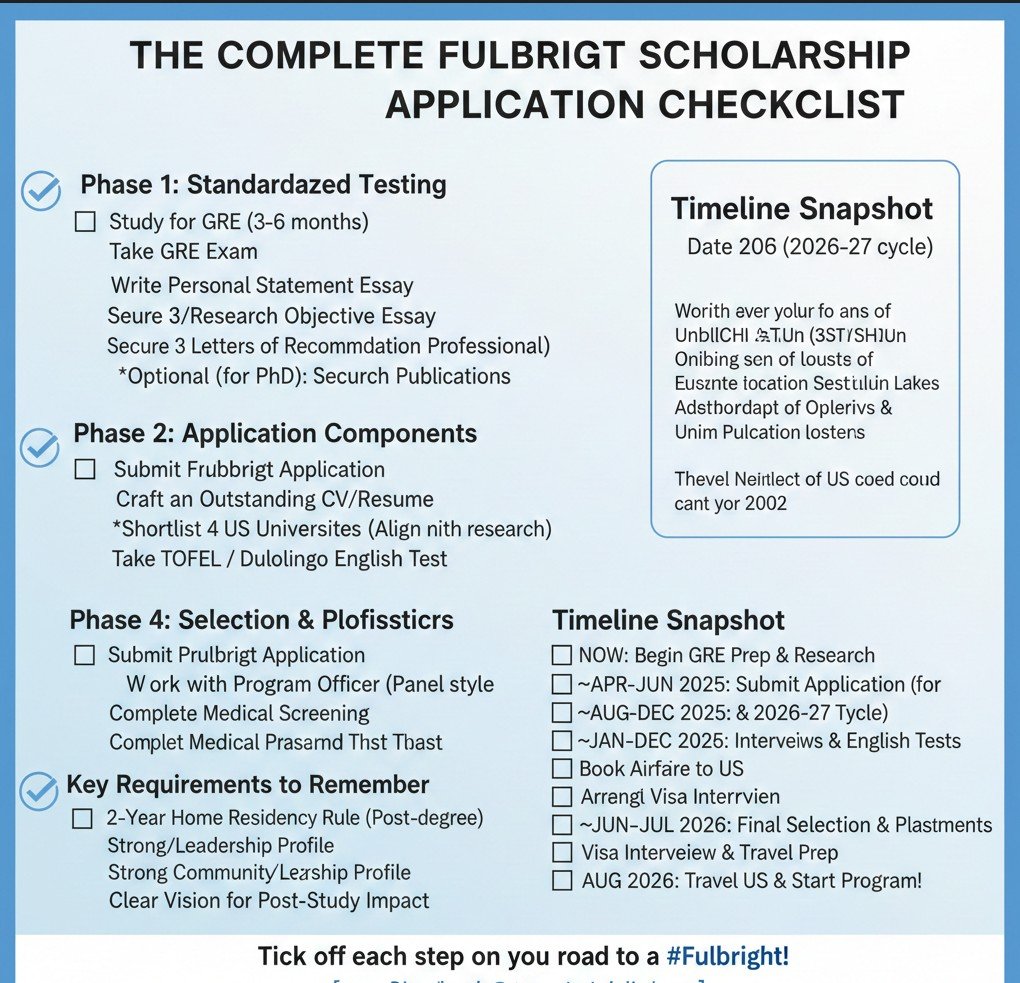
fullbrigt scholarship application checklist
Did you know that the “Fullbright trick” is simply having a clear, long-term strategy? Over the last nine years, I have helped hundreds of students avail the Fulbright Scholarship, one of the most prestigious awards offered by the United States.
The Fulbright program covers your entire tuition, living expenses, and airfare, and even provides a settlement allowance to help you transition into life in the U.S. for your Master’s or PhD. Here is the complete roadmap of what you need to do to secure this life-changing opportunity.
🔗 Quick Resource Links
Official Fulbright Information
-
Fulbright Foreign Student Program (Official Home Page) – The primary starting point for non-U.S. citizens to find country-specific deadlines and requirements.
-
Fulbright Frequently Asked Questions – Official answers from the U.S. Department of State regarding eligibility and program rules.
Standardized Testing (GRE & English Proficiency)
-
ETS: The GRE General Test – Register for the exam, find test dates, and access official practice materials.
-
TOEFL iBT (English Test) – The primary English proficiency test accepted by almost all U.S. universities.
-
Duolingo English Test – A faster, more affordable alternative that many Fulbright commissions now accept.
Phase 1: The Standardized Testing (GRE)
The first hurdle is the GRE (Graduate Record Examination). While some countries allow you to take the GRE after selection, in countries like Pakistan, it is a mandatory requirement before you even submit your application.
-
The Content: The GRE covers Middle School level math (Grades 6–8) and English.
-
The Challenge: The math is basic but presented in “tricky” ways under intense time pressure. The English portion tests reading skills and advanced vocabulary.
-
Preparation Time: * Average: 3 to 4 months.
-
If Math/English are weak: 4 to 6 months.
-
-
Pro Tip: If you aren’t a regular reader, start reading “dry” or academic articles on American history, feminism, or science to build your stamina for the reading comprehension section.
Phase 2: The Application Components
The application is where you tell your “Fulbright Story.” You need to prepare several critical documents:
1. The Essays
You must write two distinct essays:
-
Personal Statement: A narrative of who you are and your journey.
-
Study/Research Objective: A technical breakdown of what you want to study and why.
2. Letters of Recommendation (LORs)
You need three letters. Ideally:
-
One professional (from a supervisor).
-
One academic (from a professor).
-
The third can be either, depending on your strongest relationships.
3. CV/Resume
Your resume must be “outstanding.” It isn’t just a list of jobs; it needs to sound impressive to a review panel.
4. University Shortlisting
Spend at least a week researching four U.S. universities. You will need to mention these in your application, specifically looking for programs that align with your research orientation.
Phase 3: The Selection Process
Once your application is in, the review process takes roughly two months.
-
The Interview: If shortlisted, you will face a panel of 4 to 5 people. The interview can last anywhere from 1 to 25 minutes. Length does not determine success; it often depends on how much the panel needs to scrutinize your specific subject.
-
English Proficiency: After the interview, you’ll be asked to take the TOEFL or Duolingo English test.
-
The Decision: You will be notified if you are a Principal Candidate (guaranteed scholarship) or an Alternate Candidate (waiting list).
Phase 4: Placement and Logistics
After selection, a Program Officer will be assigned to you. They handle your university placements, degree verification, and medical screenings.
A Note on Placements: Even if you get into a top-tier school like Harvard or MIT, Fulbright may place you in a lower-tier university (like the University of Delaware) if the tuition is more affordable. This is a common part of the process.
Phase 5: The J1 Visa and Requirements
Fulbright scholars travel on a J1 Exchange Visa. This comes with specific conditions:
-
2-Year Home Residency Requirement: You must return to your home country for 2 years (for Masters) or 5 years (for PhD) before you are eligible to work in the U.S.
-
Dependents: Your spouse or kids can join you, but it is recommended to travel alone first to settle down. You will need a strong bank balance to prove you can support them.
Important Timeline
The U.S. academic cycle starts in August. Because the process is so thorough, you must apply one year in advance.
-
To start in August 2026: You must apply in 2025.
Fulbright isn’t just looking for the smartest student; they are looking for a leader with a story. They value diversity, giving extra weight to female candidates, those from rural areas, and minority groups.
Have any thoughts?
Share your reaction or leave a quick response — we’d love to hear what you think!
-
 0
0
-
 0
0
-
 0
0
-
 0
0
-
 0
0
-
 0
0
