Are you looking for an opportunity to move abroad, but worried that money might be a hurdle? You aren’t alone. One of the reasons I love sharing these opportunities is that many of them cost little to no money.
Today, we are talking about Italy—a country rich in history, tradition, and some of the world’s best food. More importantly, Italy is a country of “least resistance” for migrants. It offers affordable tuition, pathways to permanent residency, and the ability to move with your family.
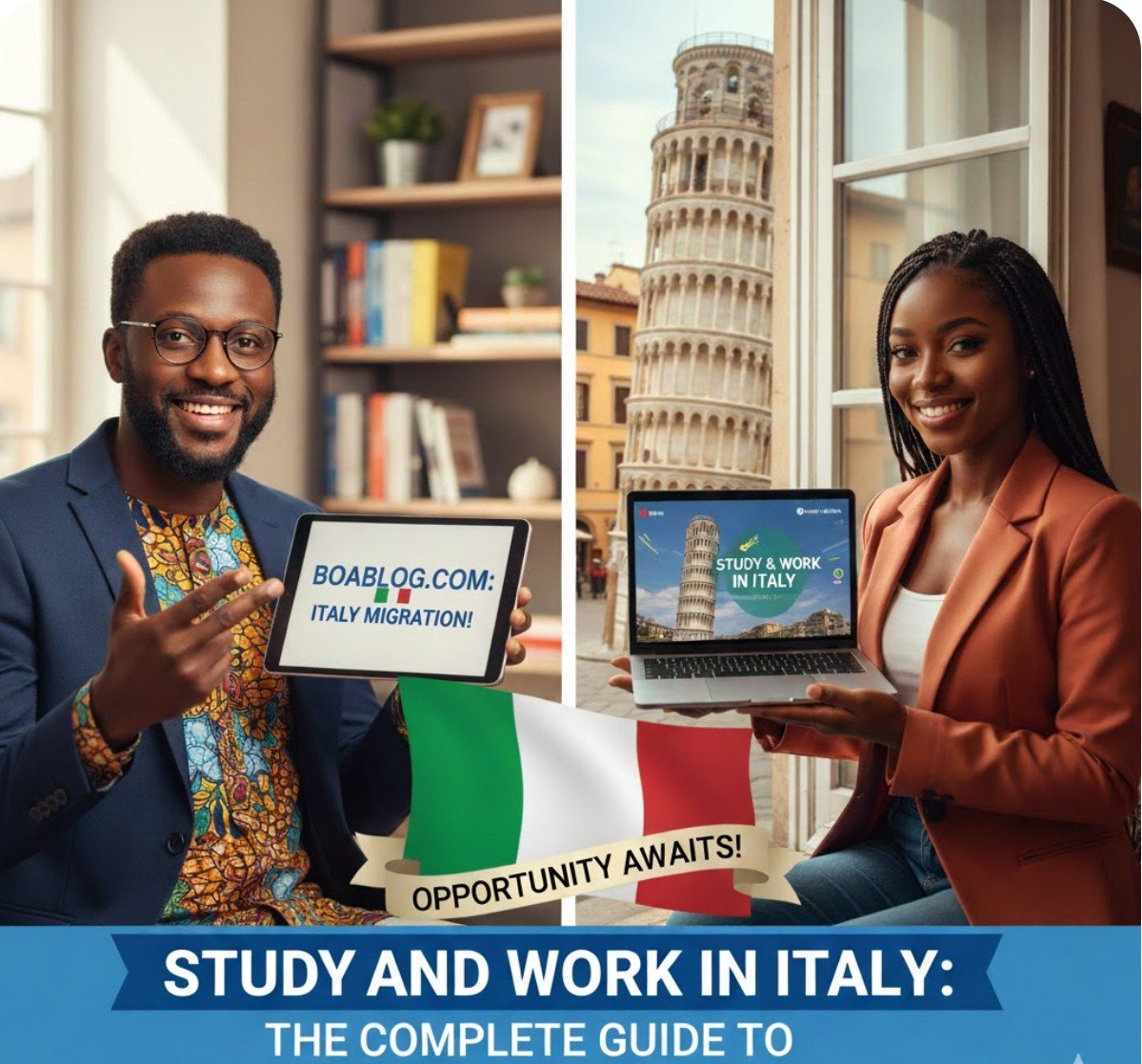
study and work in italy complete guide
Why Choose Italy?
Italy is often overlooked, but it is one of the most accessible European destinations for international students.
-
Affordable Tuition: Fees are calculated based on family income. If you come from a low-income background, your tuition could be as low as €150 to €200, or even zero.
-
Work While Studying: International students are permitted to work 20 hours per week.
-
Family Migration: While Master’s students generally cannot bring dependents immediately, PhD students have the right to move with their families.
-
Vocational Paths: Don’t have a degree? Italy has vocational schools for hospitality, culinary arts, and even welding.
The Educational Pathways
1. Degree Programs (Bachelors & Masters)
Most Master’s programs are now taught in English. While Bachelor’s degrees in English are fewer, the number is growing every year.
Key Tip: You do not always need a formal English test like IELTS or TOEFL. Often, a Proof of English Proficiency letter from your previous university is enough.
2. Vocational Schools
If you have a high school certificate (WAEC/NECO), you can apply for specialized training.
-
Italian Hospitality School: Focused on tourism.
-
Italian Chef Academy: For aspiring culinary experts.
-
Welding Programs: High-demand technical skills.
-
Note: Vocational schools are often private and can cost between €6,500 and €10,000.
Required Documents
To get started, you will need to gather the following “General Requirements”:
-
International Passport.
-
Academic Transcripts: For Master’s applications, a student copy is often sufficient for the initial evaluation.
-
Degree/Certificates: (WAEC/NECO for Bachelors; Degree for Masters).
-
Motivation Letter: A strong statement on why you chose the course and your future goals.
-
Recommendation Letters: (Required by some schools, optional for others).
Step-by-Step: From Application to Visa
-
Search for Schools: Use Universitaly.it. It is the official platform connecting all Italian universities.
-
Apply for Admission: Most windows open around November. Decision times usually take 5–6 weeks.
-
Pre-enrollment: Once admitted, you must pre-enroll on the Universitaly portal. You can only pre-enroll for one university.
-
Document Authentication: Authenticate your documents at the Ministry of Education and Foreign Affairs in your home country.
-
Translation & Legalization: Even if your degree is in English, it must be translated into Italian by an embassy-recognized translator to obtain a Declaration of Value (DOV).
-
Visa Application: Submit your legalized documents. Visa processing typically takes 0 to 90 days.
Resources & Quick Links
To help you get started on your Italian journey immediately, here are the essential links discussed in the post:
1. Official Portals
-
Universitaly.it: This is the “holy grail” of moving to Italy. It is the official gateway for searching for courses in English and completing your mandatory pre-enrollment.
-
Ministry of Foreign Affairs (Italy): Use this to find information regarding visa requirements and legalized translators recognized by the Italian embassy.
2. Universities & Vocational Schools
-
University of Padova: One of the oldest and most prestigious universities in Italy, offering the “Padua International Excellence Scholarship.”
-
Italian Chef Academy: A top-tier vocational school for those looking to enter the culinary world.
-
Italian Hospitality School: The go-to for vocational training in tourism and hotel management.
Tips for Using These Links:
-
Start with Universitaly: Before emailing anyone, spend 30 minutes on the Universitaly portal to see if your specific course is offered in English.
-
Check Regional Sites: Once you find a school, search for the “Regional Agency for the Right to Study” (often called DSU or EDISU) in that specific city to find the scholarship requirements.
Funding & Scholarships
Regional Scholarships
Italy offers regional scholarships based on financial need (your “ISEE” value). If your family income falls below a certain threshold (e.g., approx. €26,000), you may qualify for:
-
Full tuition waiver.
-
Stipends (ranging from €6,000 to €8,000 per year).
-
Subsidized accommodation and meals.
Important: Regional scholarships are usually applied for after admission. However, they are often not accepted as “Proof of Funds” for your initial visa interview.
Proof of Funds for Visa
If you don’t have a full government scholarship, the embassy generally requires proof of approximately €7,000 per year of study. For a 2-year Master’s, this is roughly €14,000. The embassy prefers sponsors who are parents or spouses.
Final Words of Advice
The entire process from application to arrival takes about six months. The biggest bottleneck is often getting an appointment for document legalization, so start early.
If you are ready to take the next step and want professional guidance, you can reach out to BoaBlog via email at arashchroki074@gmail.com. Please be respectful of her time and come prepared with your questions!
Have any thoughts?
Share your reaction or leave a quick response — we’d love to hear what you think!
-
 0
0
-
 0
0
-
 0
0
-
 0
0
-
 0
0
-
 0
0
